top of page

SCIENTIFIC REPORTS AND PUBLICATIONS

Bridging Independent Field Science with Global Action for Ecosystem Resilience.

As an international non-profit organization dedicated to the protection and conservation of marine and terrestrial ecosystems and biodiversity, RED SEA PROJECT™ places rigorous science at the heart of environmental stewardship.


Distinctively, all our research programs are solely funded by ourselves, ensuring total scientific independence, free from external commercial or political influence. Our field studies are strictly non-invasive, designed to observe, map, and protect delicate species and habitats without causing disruption. By putting data into the hands of the public, we actively empower citizen science and invest directly in coastal communities, transforming scientific discovery into collective, grassroots action.

Guided by Science, Anchored in Ethics

At RED SEA PROJECT™, we uphold a set of core ethics and best practices that guide the design, implementation, and evaluation of our operation. These commitments reflect our dedication to ethical, sustainable development and our responsibility to create meaningful, positive impact while minimizing any unintentional harm.

Our Ten Ethical Commitments - RED SEA PROJECT™

Scientific Publications

Population density and abundance of Gree

Population density and abundance of Green Turtles Chelonia mydas in one of the largest feeding grounds in the Egyptian Red Sea

Green turtles (Chelonia mydas) are globally endangered and very little is known about their population in Egypt’s Red Sea...

Recent observations on green turtle Chel

Recent observations on green turtle Chelonia mydas movements and nesting in the Egyptian Red Sea

Conservation of sea turtles requires identifying vital habitats such as nesting beaches and feeding grounds. Through a citizen science programme that records flipper tags and takes ID photos...

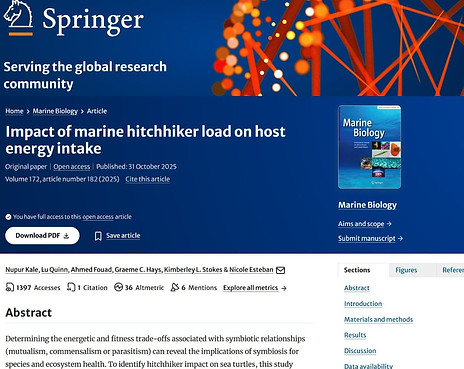
Impact of marine hitchhiker load on host energy intake.jpg

Impact of marine hitchhiker load on host energy intake

Determining the energetic and fitness trade-offs associated with symbiotic relationships (mutualism, commensalism or parasitism) can reveal the implications of symbiosis for species and ecosystem health...

A citizen science approach to studying injury and mortality patterns of sea turtles in the

A citizen science approach to studying injury and mortality patterns of sea turtles in the Egyptian Red Sea

Studies of the injury and mortality patterns of sea turtles are vital to understanding what is needed for threatened and endangered species to recover. The objective of this research was to use citizen science sourced data...

_Monitoring environmental DNA (eDNA) of sharks in the Red Sea and its relationship to the

Monitoring environmental DNA (eDNA) of sharks in the Red Sea and its relationship to the microbiome

Limited studies have investigated the Red Sea shark population and recent studies have mainly investigated the shark population on the Saudi Arabian side of the Red Sea...

Treatment of Red Sea Hawksbill Turtle, Eretmochelys Imbricata Suffered from Floating Syndr

Treatment of Red Sea Hawksbill Turtle, Eretmochelys Imbricata Suffered from Floating Syndrome Using Activated Charcoal-Simethicone Combination

A juvenile Hawksbill Sea turtle, Eretmochelys imbricata was
admitted to the diagnosis and treatment unit of the National Institute of Oceanography and
Fisheries, Hurghada in June 2022...

Assessing the Long-Term Sex Ratio and Stranding and Injury Patterns of Sea Turtles in Aqab

Assessing the Long-Term Sex Ratio and Stranding and Injury Patterns of Sea Turtles in Aqaba, Jordan

Jordan’s last population assessment of sea turtles in Aqaba was conducted in 2003-2004. Hawksbill turtles are the most common species in Aqaba, with green turtles being the second most common....

A Citizen Science Approach to Studying the Demographics and Injury Patterns of Spinner Dol

A Citizen Science Approach to Studying the Demographics and Injury Patterns of Spinner Dolphins in the Egyptian Red Sea

Cetacean monitoring is often expensive and challenging, however citizen science provides an alternative approach to studying spinner dolphins. Understanding population demographics, including.....

Institutional Collaborators & Research Partners

Ministry of Environment
National Institute of Oceanography and Fisheries .png
Cetacean Sanctuary Research.png
UNDP Jordan.png
Swansea University.png
University of Louisville.png
Indiana University Southeast.png
The King Abdullah University of Science and Technology.png
Deakin University.png
Nanyang Technological University.png
National Parks of Egypt.png
Aqaba Marine Reserve.png
Al-Azhar Univerist.png
The Royal Marine Conservation Society of Jordan.png
New Mexico State University.png
The Robinson Center for Young Scholars.png
Conservation X Labs.png
The American University in Cairo .png
bottom of page